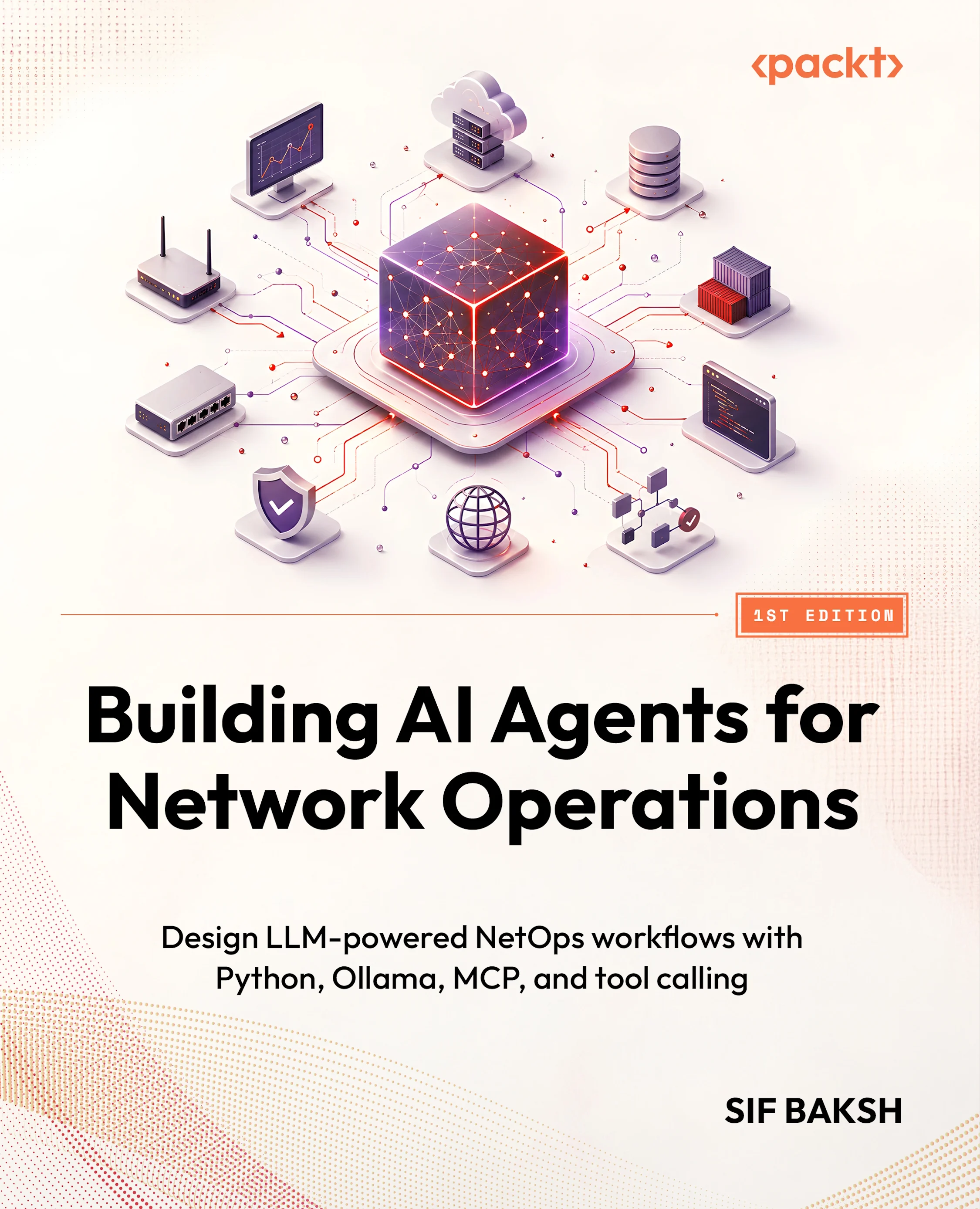
Review of “AI Agents for Network Operations” by Sif Baksh
Most network engineers don’t wake up thinking about tokens or context windows. We wake up thinking about why BGP is down, why an alert fired, and why the dashboard is green while the ticket says everything is broken.
So when a book puts “AI Agents” and “Network Operations” in the same title, my first reaction is usually a quiet “here we go.” I’ve seen enough demos where AI gets bolted onto a workflow that a plain script already handled better.
This book is not that. And that’s exactly why I want to talk about it.
What makes it different
It’s engineering-led, not hype-led. Sif never asks you to trust the model. The whole book is built on one honest definition:
agent = LLM + code + tools + context + guardrails
It follows the same principles of general network engineering and automation: start small, validate, and build up.
Who it’s for
Network engineers, NOC and NetOps folks, SREs, and automation people who are curious about agents but allergic to hype. You’ll want basic Python and comfort with routing/BGP/CLI, but the labs explain the patterns as they go. If you already live in production networks, the read-only-first, human-in-the-loop framing will feel like someone finally gets it.
What you actually build
It’s a build journey, not a theory dump. You start small and add one piece at a time:
- LLM fundamentals, running locally with Ollama (llama3.2 and deepseek-r1). No API keys, no cloud bill, it runs on your laptop.
- The RACE prompt framework (Role, Anchors, Context, Expected output) for prompts you can actually reuse
- Turning messy CLI output into validated JSON, and validating it before you trust it
- A chatbot with memory, then tool calling, then a real troubleshooting agent
- Packaging tools as reusable services with MCP
- A full production-readiness chapter that takes the lab agent all the way to a real go/no-go review (more on this below, it’s the standout)
What I liked
There are a few topics that I liked: clear use cases, network engineer principles, and production-readiness. Overall it’s an easy and readable book, having a good balance between theory and hands-on practice.
Clear use cases
The book is full of practical examples, and the labs are designed to be useful in real-world scenarios. The troubleshooting agent you build can be adapted to your own network, and the principles you learn can be applied to other areas of network operations.
Network engineer principles
The book emphasizes to be careful with AI, production networks and keeps all labs and theory in that perspective. For network engineers, this is something very important to keep in mind, and Sif does a great job of keeping the focus on the engineering principles that are essential for building reliable and effective AI agents.
Production-readiness
Instead of just showing you how to build an agent, the book takes you through the steps to make it production-ready. This includes adding RBAC, audit logging, and go/no-go review. This is a standout feature of the book, as it shows you how to take an agent from a lab environment to a real-world production environment.
One honest note
The labs are intentionally mocked and read-only, so you won’t finish with a drop-in production agent. You’ll finish with something better: the judgment to design, test, and review one safely against your own environment.
Conclusion
This is one of the few AI-for-networking resources that treats AI the way we should, as a controlled component inside an engineered workflow, not a magic box. It won’t tell you AI will replace you. It shows you how to put AI to work while keeping validation, visibility, and control where they belong: with the engineer.
If you’ve been wondering how to bring agents into NetOps without losing your ability to trust the result, this is the book I’d hand you.
Kudos to Sif Baksh for writing the practical, grounded version of this book instead of the flashy one. It has earned a spot on my bookshelf.
Get your copy of the book here: AI Agents for Network Operations