Review of the Certified Associate: AI Infrastructure and Operations (NCA-AIIO) by NVIDIA
Looking for an AI certification that isn’t mostly about LLMs, prompt engineering, or the latest generative AI hype?
A lot of AI courses and certifications seem to start with the same topics: models, tokens, prompts, and chatbots. Useful subjects, sure, but not necessarily what you’re looking for if your day-to-day work is closer to infrastructure and operations.
The NVIDIA NCA-AIIO takes a different route. It focuses on the infrastructure behind AI: GPUs, networking, data centers, deployment, monitoring, and operating AI environments.
This certification is not about becoming a prompt engineer. And that’s exactly why I wanted to take it.
What is it about?
Simply put, it’s about what’s under the hood.
To give you an idea how far that goes: there are exam topics on liquid cooling for GPUs inside data center racks. Don’t worry, you won’t need the physics. But you will need to know why a rack full of GPUs can’t be cooled with air, why data moves between those GPUs without the CPU ever touching it, and what a GPU is telling you when it starts throttling.
What you will learn
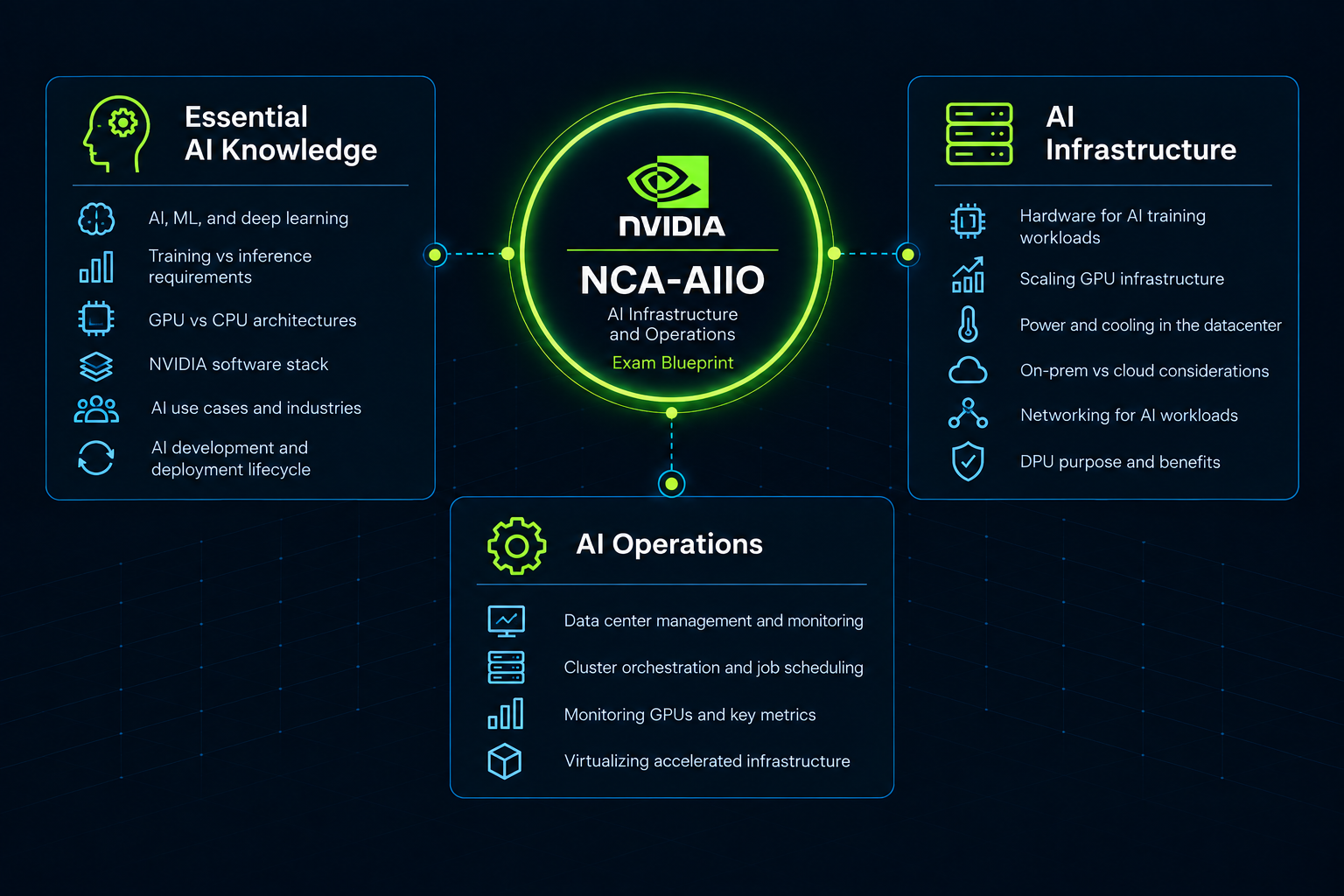
If we follow the official blueprint, the exam is broken down into three main topic areas:
- Essential AI Knowledge (38% of the exam)
- AI Infrastructure (40% of the exam)
- AI Operations (22% of the exam)
Let’s break it down.
Essential AI Knowledge
Artificial Intelligence is a broad umbrella term. Machine learning trains a model on data so it can predict on data it has never seen. Deep learning does the same with neural networks that work out for themselves which features matter, instead of a human choosing them. Generative AI creates new content instead of predicting a value. Each one is a subset of the one before it.
From there you cover supervised, unsupervised and reinforcement learning, and what a transformer actually is. You also learn why a GPU beats a CPU at this kind of work, which comes down to a handful of fast cores each doing something different against thousands doing the same multiplication at once. And the NVIDIA stack: CUDA, TensorRT, Triton, NeMo, and the NGC Catalog you pull containers and pretrained models from.
You will also learn what the difference is between training and inference for an AI model, and what NVIDIA offers to solve the problems each one creates. Training a model needs high-bandwidth connections between GPUs and storage clusters. Inference needs low-latency networks to interact with agents or users.
AI Infrastructure
The second part of the certification focuses on the infrastructure required to support AI workloads. This includes hardware requirements, scaling GPU infrastructure, power and cooling considerations, networking requirements, and more.
So what is the difference between scale-up and scale-out? Scale-up is inside the box: NVLink wiring GPUs directly to each other, and NVSwitch for when point-to-point is not enough and you want every GPU in the node talking to every other one at full rate. Scale-out is everything between nodes, and that is where you pick between InfiniBand and Ethernet. Spectrum-X is the Ethernet answer, and RoCE is how RDMA rides on it.
Which brings up RDMA. It moves data straight out of one machine’s memory into another’s without the CPU ever touching it, and with GPUDirect the NIC writes directly into GPU memory. For anyone who has spent a career thinking in terms of packets and CPUs, that is a strange and interesting idea.
Now for the genuinely cool part: power and cooling. A normal enterprise rack draws single-digit kilowatts. A rack of GPUs is an order of magnitude past that, and somewhere along the way air stops working and you are into direct-to-chip liquid cooling, coolant distribution units, and a floor that can carry the weight. You end up asking whether the building can host this at all, which is a very different conversation from the one we usually have about capacity.
The rest is the decisions around all that. What hardware a given training job actually needs, when to scale a cluster versus rent one, what a DPU like BlueField takes off the host CPU, and the honest trade-offs between on-premises and cloud.
AI Operations
The final part of the certification focuses on the operations and management of AI environments. This includes data center management, monitoring, cluster orchestration, job scheduling, and virtualization of accelerated infrastructure.
Monitoring is where it got interesting. DCGM gives you the GPU telemetry, but the lesson is that GPU utilization lies. A card can report 100% while doing almost nothing useful, because all that number means is that something was running. The signals worth watching are memory bandwidth, power draw, and why a GPU is throttling. A training job that suddenly runs slower might be a cooling problem, not a code problem, which ties straight back to the racks.
Scheduling has its own twist. A distributed training job needs all its GPUs at once: you cannot start a 64-GPU job with 60 and catch up later. Slurm and Kubernetes with the GPU Operator both show up here, and so does the uncomfortable fact that an idle GPU is the most expensive thing in the building.
Then virtualization, where MIG splits one physical GPU into isolated instances with their own memory and compute. Not every workload deserves a whole card.
What I liked
It is refreshing to learn how things actually work under the hood. So instead of building yet another AI agent with an MCP server, you can learn how to build the infrastructure that will support it. These are the things I really liked:
- Use cases showing how companies transform their businesses with AI
- Physical data center solutions with HGX and DGX devices
- Cooling and airflow requirements within the rack
- The amazing RDMA solution to the challenges of GPU-to-GPU communication
- What kind of different AI workflows are out there
How I prepared
Three things worth your time:
- Course AI Infrastructure and Operations Fundamentals
- Learning Guide Found under
Review Study Guide - Extra (unofficial) Learning Guide Preporato
That covers the material. Knowing whether it stuck is a separate problem.
So, since we are learning about AI, why not use AI to prepare? I put my notes and the blueprint into a git repository and loaded it into a RAG agent, then had it generate multiple-choice questions per blueprint section. Almost every question was new, so there was nothing to memorize.
That is the part that mattered. This was not brain dumping. A question I had never seen before showed me straight away whether I understood the topic or just recognized the wording, and when I got one wrong I had to explain why the right answer was right.
A simple prompt that was very effective was:
As a student studying for the NVIDIA NCA-AIIO certification, I want to practice before the exam.
I want to specifically practice this blueprint section:

{{ Blueprint section }}

With this subject:

{{ Subject }}

You should give me multiple choice questions. They should be questions that I could expect on the exam.

Do not show the answer directly, only when I have given the response.
Answer with why it's correct or wrong.

Only one question per response
Use cases and scenarios
So what are some of the use cases and scenarios that I’m now better able to reason about?
A company is looking for a new AI solution
Let’s say a startup wants to build an AI solution that can predict how its customers will behave. However, it doesn’t have the people or resources required to build and maintain its own AI factory or large-scale AI infrastructure.
Another challenge is data. The company may not yet have enough high-quality data to train an effective model, while privacy and security requirements may restrict how customer data can be used.
For this scenario, I can now answer questions such as:
Because the company has limited infrastructure and operational resources, a cloud-first approach could make more sense than immediately building an on-premises GPU environment. NVIDIA AI Enterprise could provide the supported software stack for developing, deploying and managing AI workloads across cloud or on-premises infrastructure.
The compute platform should be selected based on the actual workload. A dedicated NVIDIA DGX system could make sense for organizations that require high-performance on-premises training, but for a startup with variable workloads and limited infrastructure staff, consuming GPU resources from the cloud may be a better starting point.
Synthetic data could be used to supplement limited or sensitive datasets. Generative models can create synthetic data that resembles the statistical characteristics of real data, helping with data scarcity and, when implemented correctly, privacy. However, synthetic data still needs to be validated for quality, bias and privacy.
Multiple departments are looking for a shared GPU cluster
In this scenario, multiple departments within a company want to share a GPU cluster for their AI workloads. The goal is to prevent expensive GPU resources from being underutilized while allowing different teams to share the infrastructure.
For this scenario, I can now answer questions such as:
A scheduler such as Slurm can be used for HPC-style and AI training workloads, allocating GPUs, CPUs and memory to jobs. Kubernetes can provide container-based orchestration, while platforms such as Run:ai can add GPU-aware scheduling, quotas and resource-sharing capabilities for multiple teams.
Technologies such as MIG can partition supported GPUs into isolated GPU instances, allowing multiple workloads or users to share the same physical GPU while maintaining resource isolation.
The NVIDIA NGC Catalog can provide teams with GPU-optimized containers, pretrained models and SDKs. Instead of every department building its software environment from scratch, they can start with optimized and repeatable software components.
NVIDIA DCGM can be used to monitor GPU utilization, memory, temperature, power, errors and overall GPU health. These metrics can also be exported to monitoring platforms such as Prometheus and Grafana.
Company-specific models
A scenario that I think will become increasingly important is companies wanting to run AI models under their own control.
Privacy, security, data sovereignty, regulatory requirements or company policy may make the use of externally hosted public AI services unsuitable. That does not necessarily mean that a company has to create an entirely new model from scratch. It could self-host an existing model, customize or fine-tune one, or train a new model depending on the requirements.
So how would we approach this scenario?
Does the company actually need to train a completely new model, or could an existing pretrained model be adapted to the use case?
Where does the company’s data need to reside? Can the workload run in the cloud, does it need to remain on-premises, or would a hybrid architecture make more sense?
Does the existing infrastructure have enough GPU compute and memory capacity for training and inference?
Can the storage infrastructure provide enough throughput to continuously feed the GPUs without becoming a bottleneck?
Does the network provide the bandwidth and low latency required for distributed GPU workloads, for example using InfiniBand or high-performance Ethernet with RDMA?
Can the data center provide enough power, rack density and cooling for the required GPU systems? High-density AI infrastructure may require changes to power distribution, airflow or direct liquid cooling.
Does the organization have the orchestration, monitoring and MLOps processes required to schedule workloads, monitor GPU infrastructure, deploy models and manage them throughout their lifecycle?
These are the kinds of questions that the NCA-AIIO certification helped me understand. It doesn’t turn you into an AI engineer or data scientist, but it gives you a much better understanding of the infrastructure, software and operational decisions behind running AI at scale.
Conclusion
With many certifications out there in the network infrastructure space, a big part is always the vendor’s own products, in this case the NVIDIA software stack, NVIDIA GPU solutions and best practices. But this certification is not only about the products, but also about the concepts and principles behind AI infrastructure and operations.
It gave me personal insights into how my network engineering world is going to take shape in the future, and how to prepare for it.
If you ask me, this certification will make me ready for when the time comes that a company asks me to design and implement an AI infrastructure solution that includes a hybrid of on-premises and cloud solutions.
Proudly, I can say that I passed the exam and earned the certification. And I can add it to my certifications page.
Resources
- NVIDIA Certification page AI Infrastructure and Operations (NCA-AIIO)
- Course AI Infrastructure and Operations Fundamentals
- Learning Guide Found under
Review Study Guide - Extra (unofficial) Learning Guide Preporato
This page was made with the help of several generative AI and AI-assisted tools for research, fact-checking, spelling, grammar, and image generation.